


Political Empowerment of Women (in Local Government)

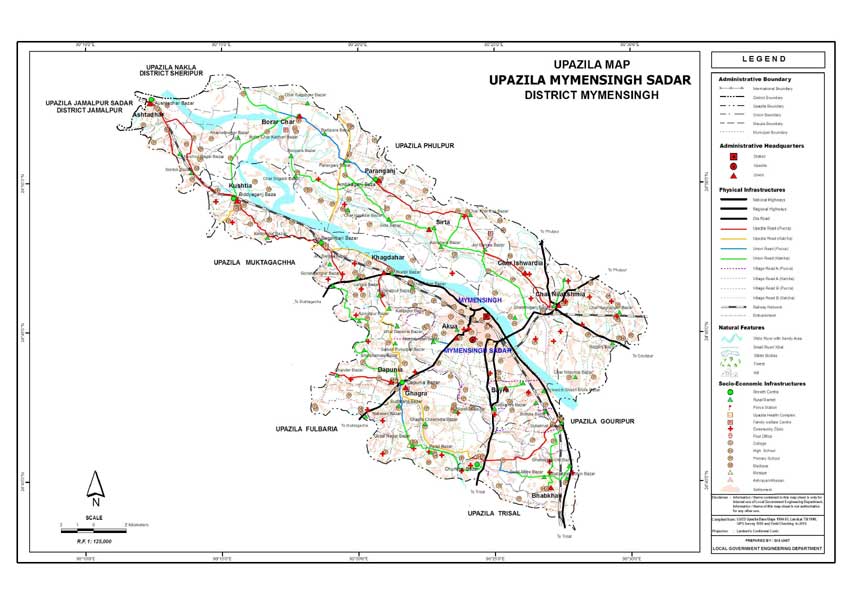
Mymensingh
Sadar Upazila
Mymensingh Sadar Upazila (MYMENSINGH district) with an area of 388.45
sq km, is bounded by NAKLA and PHULPUR upazilas on the north, TRISHAL
and FULBARIA upazilas on the south, ISHWARGANJ and GAURIPUR upazilas
on the east, MUKTAGACHHA and JAMALPUR SADAR upazilas on the west. Main
rivers are Old Brahmaputra, Sutia and Negeshwari.
Mymensingh (Town) was earlier called Nasirabad. It stands on
the bank of the Brahmaputra. It consists of 21 wards and 85 mahallas.
The area of the town is 21.73 km. It has a population of 225811; male
51.91%, female 48.09%; density of population per sq km 10392 per sq
km. Literacy rate among the town people is 60.4%.
Administration: Mymensingh Sadar thana, now an upazila, was
established in 1867. The upazila consists of 1 municipality, 14 union
parishads, 136 mouzas and 173 villages.
Archaeological heritage and relics: House of Maharaj Shashikanta,
Alexandra Castle, Raj Rajeswari Water Tank and "Rabindra Batamul
Smritimancha" (in memory of the visit of Mymensingh by Rabindranath
Thakur in 1926), most noted items in the Mymensingh Museum are ancient
manuscripts of the Mahabharat, Vishnu statue made of black basalt,
manuscripts of Gitagovinda of Joydev, manuscripts of the poems of
Chandidas, photocopy of the first postal stamp, sword of the zamindar
of Muktagachha, World Map (1645), greater Map of the Mymensingh (1779)
by Kedarnath Majumder.
Historical events: During the War of Liberation the Pakistan
army attacked Digharkandha village at mid night. The villagers resisted
the attack with indigenous weapons and killed a Pakistan army officer.
In retaliation the Pakistan army killed many villagers next day.
Marks of War of Liberation Mass killing site: river side of Dakbungalow
Char, Bangladesh Agricultural University campus.
Population: 566368; male 52%, female 48%; Muslim 92.42%, Hindu
7.3%, Christian 0.22% and others 0.06%; ethnic nationals: Garo 97
family.
Religious institutions: Mosque 682, temple 22 and church 2,
sacred place 3, tomb 9, noted of which are Mymensingh Baro Mosque,
Ganginapar Mosque, Durgabari Temple, Panditbari Temple, Vatikashwar
Swadhu Patrick Church, Jubileeghat pilgrimage.
Literacy and educational institutions: Average literacy 37%;
male 42.8% and female 30.6%. Educational institutions: university
1, medical college 2, college 22, teacher's training institute 2,
technical educational institutions 6, high school 50, madrasa 21,
maktab 210, government primary school 150, non-government primary
school 43. Noted educational institutions: Bangladesh Agricultural
University 91961), Anandamohon Government College (1908), Mymensingh
Medical College, Mymensingh Zila School (1853) and Girl's Cadet College.
Locally published newspapers and periodicals: The daily Jahan,
Ajker Bangladesh, Swadesh Sangbad, Banglar Jamin; extinct: Saurav,
weekly Takbir and Banglar Chashi.
Cultural organisations: Club 12, library 18, museum 1, cinema
hall 5, drama stage 2, theatre party 5, opera party 1, literary society
4, women's organisation 2, playground 36.
Main occupations: Agriculture 25.95%, agricultural labourer
14.24%, wage labourer 4.89%, commerce 16.92%, service 16.45%, others
21.55%.
Land use: Total cultivable 24662.88 hectares, fallow land 718.72
hectares; single crop 23.32%, double crop 47.38% and treble crop land
29.30%.
Value of land: The market value of the land of the first grade
is Tk 10000 per 0.01 hectare.
Main crops: Paddy, wheat, potato, brinjal, onion, garlic and
patal.
Extinct and nearly extinct crops: Mustard seed, linseed and
arahar.
Main fruits: Jackfruit, mango, banana, papaya litchi and watermelon.
Fisheries, dairies, poultries Fishery 63, dairy 6, poultry 54 and hatchery
17.
Communication facilities Roads: pucca 100 km, semi pucca 45 km
and mud road 590 km; railways 51 km.
Traditional transport: Palanquin, bullock cart and horse carriage.
These means of transport are either extinct or nearly extinct.
Manufactories: Jute mill 1, flour mill 3, ice factory 3, press
8, tannery 1 and engineering workshop 8.
Cottage industries: Weaving 8, bamboo work 73, goldsmith 67,
blacksmith 84, potteries 103, wood work 178, tailoring 297, bidi factory
2, welding 25 and silk works 2.
Hats, bazars and fairs: Hats and bazars are 36, most noted
are Baro Bazar, Natun Bazar, Churkhai Bazar and Dapunia Bazar; fairs
4.
Main exports: Paddy, banana, leather and vegetables.
NGO activities: Operationally important NGOs are BRAC, GRAMEEN
BANK, Gonosahajya Sangstha and SDS.
Health centres: Hospital 5, upazila health complex 1, satellite
clinic 3 and family welfare centre 13. [Azahar Sarkar