


Political Empowerment of Women (in Local Government)

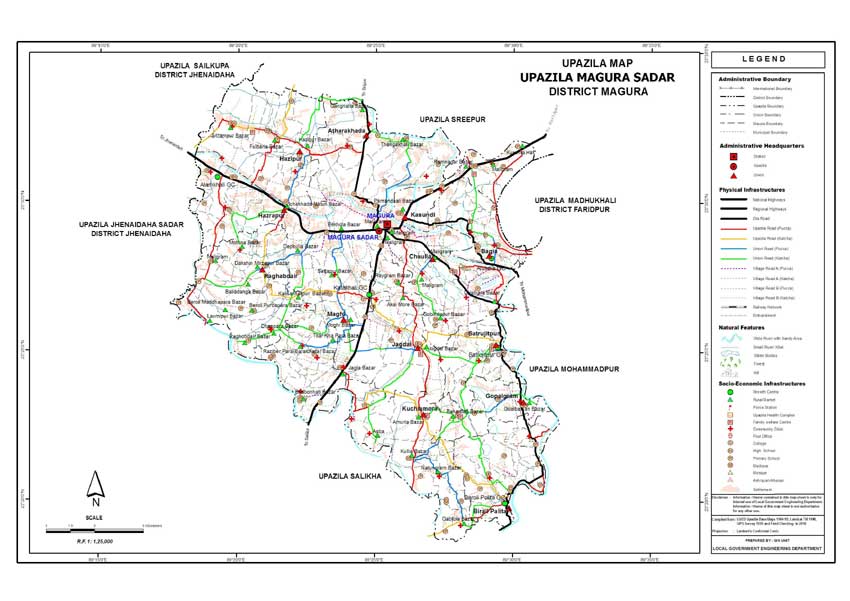
Magura Sadar
Upazila
Magura Sadar Upazila (MAGURA district) with an area of 406.50 sq km,
is bounded by SREEPUR (Magura) and SHAILKUPA upazilas on the north,
SALIKHA upazila on the south, MOHAMMADPUR (Magura) upazila on the east,
JHENAIDAH SADAR upazila on the west. Main rivers are Gorai, Nabaganga
and Fatki; Sirijdia, Padma, Kumar and Gazar Garai Beels are notable.
Magura (Town) consists of 18 wards and 61 mahallas. The area
of the town is 22.95 sq km. It has a population of 85216; male 51.69%,
female 48.31%. Density of population is 3713 per sq km. Literacy rate
among the town people is 47.6%.
Administration: Magura thana was turned into an upazila in
1983. The upazila consists of one municipality, 18 wards, 13 union
parishads, 263 mouzas and 252 villages.
Archaeological heritage and relics: Neelkuthi (Ichakhada),
Beparipara Jami Mosque (Parnanduali), tomb of Pir Mokarram Ali (Hajipur),
Siddheshwari Math (Darimagura).
Marks of War of Liberation Memorial monument adjacent to the Bishwas
road.
Population: 286925; male 51.41%, female 48.59%; Muslim 78.54%,
Hindu 21.28% and others 0.18%.
Religious institutions: Mosque 250, temple 55, church 1, tomb
1 and place pilgrimage 3. Most noted religious institutions are Magura
Jami Mosque, Beparipara Jami Mosque (Parnanduali), tomb of Pir Mokarram
Ali (Hajipur), Kalibari Mandir, Ashram of Nangta Baba (Satdoha), Math
and Mission at Hajratal and Sidweswari Math (Darimagura).
Literacy and educational institutions: Average literacy 30.5%;
male 41.6% and female 19.4%. Educational institutions: college 5,
high school 32, madrasa 2, government primary school 105, non-government
primary school 42, technical institute 1. Noted educational institutions
are Government Hussain Shahid Sohrawardhi College (1940), Magura Government
Boys' High School (1854), Hajipur High School (1914), Shatrujitpur
Kaliprasanna High School (1919).
Cultural organisations: Club 80, public library 3, cinema hall
2, theatre group 4, opera party 2, literary society 2, women's organisation
3.
Locally published newspapers and periodicals Daily: Khedmat;
weeklies: Magura Barta, Grameen Bangla, Ganasangbad and Angikar; monthly:
Nabaganga.
Main occupations: Agriculture 46.06%, agricultural labourer
18.06%, wage labourer 3.29%, industry 1.21%, commerce 11.37%, service
7.84%, transport 3.57%, construction 1.43%, and others 7.17%.
Land use: Total cultivable land 27140.83 hectares, fallow land
141.85 hectares; single crop 25%, double crop 55% and treble crop
land 20%; land under irrigation 78%.
Land control: Among the peasants, 15% are landless, 35% small,
42% intermediate and 8% rich; land per head 0.12 hectare.
Value of land: The market value of the land of the first grade
is Tk 7000 per 0.01 hectare.
Main crops: Paddy, jute, wheat, mustard seed, brinjal, sugarcane,
chilli, onion, chhola and musuri dal (pulse).
Extinct or nearly extinct crops: Sweet potato, indigo, kaun
and arahar.
Main fruits: Mango, jackfruit, black berry, papaya, bel (wood
apple) and litchi.
Fisheries, dairies, poultries Poultry 20, fishery 50 and hatchery 4.
Communication facilities Roads: pucca 155 km, semi pucca 75 km
and mud road 750 km.
Traditional transport: Palanquin, motor launch, horse carriage,
boat, buffalo cart and bullock cart. These means of transport are
either extinct or nearly extinct.
Manufactories: Textile mill 2, plastic pipe factory 1, soap
factory 1, ice factory 10, bidi factory 1, lather factory 18 and welding
135.
Cottage industries: Weaving 20, bamboo and cane work 325, blacksmith
150, goldsmith 70, potteries 200, wood work 105 and tailoring 500.
Hats, bazars and fairs: Total number of hats and bazars is
30, most noted of which are Magura Ekata Kacha Bazar, Satrujithpur,
Ichhakhada, Alokdia, Katakhali Hat; fairs 8, most noted of which are
Rathkhola Mela, Katayani Mela and Baishakhi Mela.
Main exports: Jute, cotton, papaya, green chilli, onion and
brinjal.
NGO activities: Operationally important NGOs are BRAC, ASA,
PROSHIKA, Swanirvar Bangladesh, Seba, Prime and ADI.
Health centres: Hospital 1, upazila health complex 1, child
hospital 1, eye hospital 1, diabetic hospital 1, maternity hospital
1, family welfare centre 13 and satellite clinic 7. [Ranjit Kumar
Basu]