


Political Empowerment of Women (in Local Government)

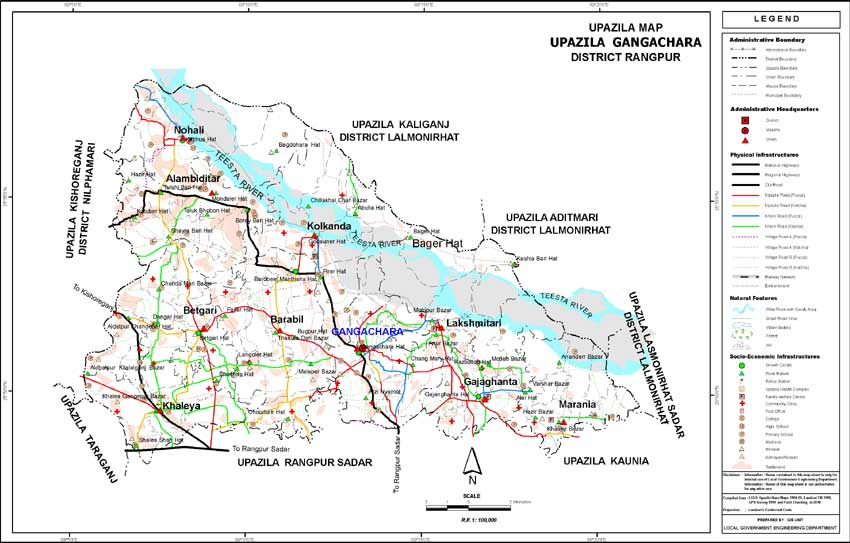
Gangachara Upazila
Gangachara (Town) consists of two mouzas. It has an area of 9.86
sq km. The town has a population of 12600; male 52.02%, female 47.98%.
The density of population is 1278 per sq km. Literacy rate among the
town people is 28.6%. Gangachara is noted for tobacco production.
Administration: Gangachara thana, now an upazila, was established
in 1917. The upazila consists of 10 union parishads, 73 mouzas and
123 villages.
Archaeological heritage and relics: Mandail Mosque at Barabeel,
Hari Mandir at Chandanhat and Thakurdaha Mandir.
Marks of the War of Liberation: A Memorial monument at Mahipur.
Population: 192336; male 52.04%, female 47.96%; Muslim 86.53%,
Hindu 13.43% and others 0.04%.
Religious institutions: Mosque 305, temple 48.
Literacy and educational institutions: Average literacy 22.4%;
male 29%, female 15.1%. Educational institution: college 5, high school
26, junior high school 5, madrasa 33, government primary school 84,
non-government primary school 77, kindergarten 1, community school
5, music school 1 and satellite school 18.
Cultural organisations: Club 56, orphanage 4, cinema hall 2,
theatre group 2.
Main occupations: Agriculture 43.94%, agricultural labourer
32.53%, wage labourer 6.11%, commerce 7.44%, service 3.28% and others
6.7%.
Land use: Total cultivable land 18823 hectares; single crop
37.34%, double crop 11.9% and treble crop 50.76%; land under irrigation
66.9%.
Land control:Among the peasants 48% are landless, 28% small,
14% intermediate and 10% rich.
Value of land: The market value of the land of the first grade
is Tk. 7500 per 0.01 hectare.
Main crops: Paddy, jute, wheat, potato, ginger and vegetables.
Extinct or nearly extinct crops: Linseed, sesame, sweet potato
and kaun.
Main fruits: Mango, jackfruit, black berry, papaya and banana.
Fisheries, dairies, poultries Poultry 4, fishery 7.
Communication facilities Roads: pucca 25 km, semi pucca 5 km
and mud road 295 km; waterways 14 nautical mile.
Traditional transport: PALANQUIN and bullock cart. These means
of transport are either extinct or nearly extinct.
Manufactories: Tobacco crushing mill 7, rice mill 10, saw mill
6 and welding 7.
Cottage industries: Bamboo work 35, weaving 20, goldsmith 3,
blacksmith 27, potteries 37, wood work 17, tailoring 35 and bidi 11.
Hats, bazars and fairs: Total number of hats and bazars are
9, most noted of which are Gajaghanta, Mahipur, Gangachara, Maulvibazar,
Betgari, Manthana, Bakshiganj, Khaprikhal and Chowdhury Hat; noted
fair: Sharif Mela at Pakuria.
Main exports: Tobacco, ginger and vegetables.
NGO activities: Operationally important NGOs are BRAC, ASA,
GRAMEEN BANK, Thengamara Mahila Sabuj Sangha.
Health centres: Upazila health complex 1, family planning centre
10, satellite clinic 2. [Md. Abdus Sattar]